JD.com Supports TNG: From E-Commerce to Supply Chain Strategic Upgrades
Cross-Border E-Commerce Enters the “Local Wallet” Competition Stage
For Malaysian consumers, the pain points of cross-border shopping have never been limited to “whether they can buy Chinese products,” but also “whether they can pay using a method they are familiar with.”
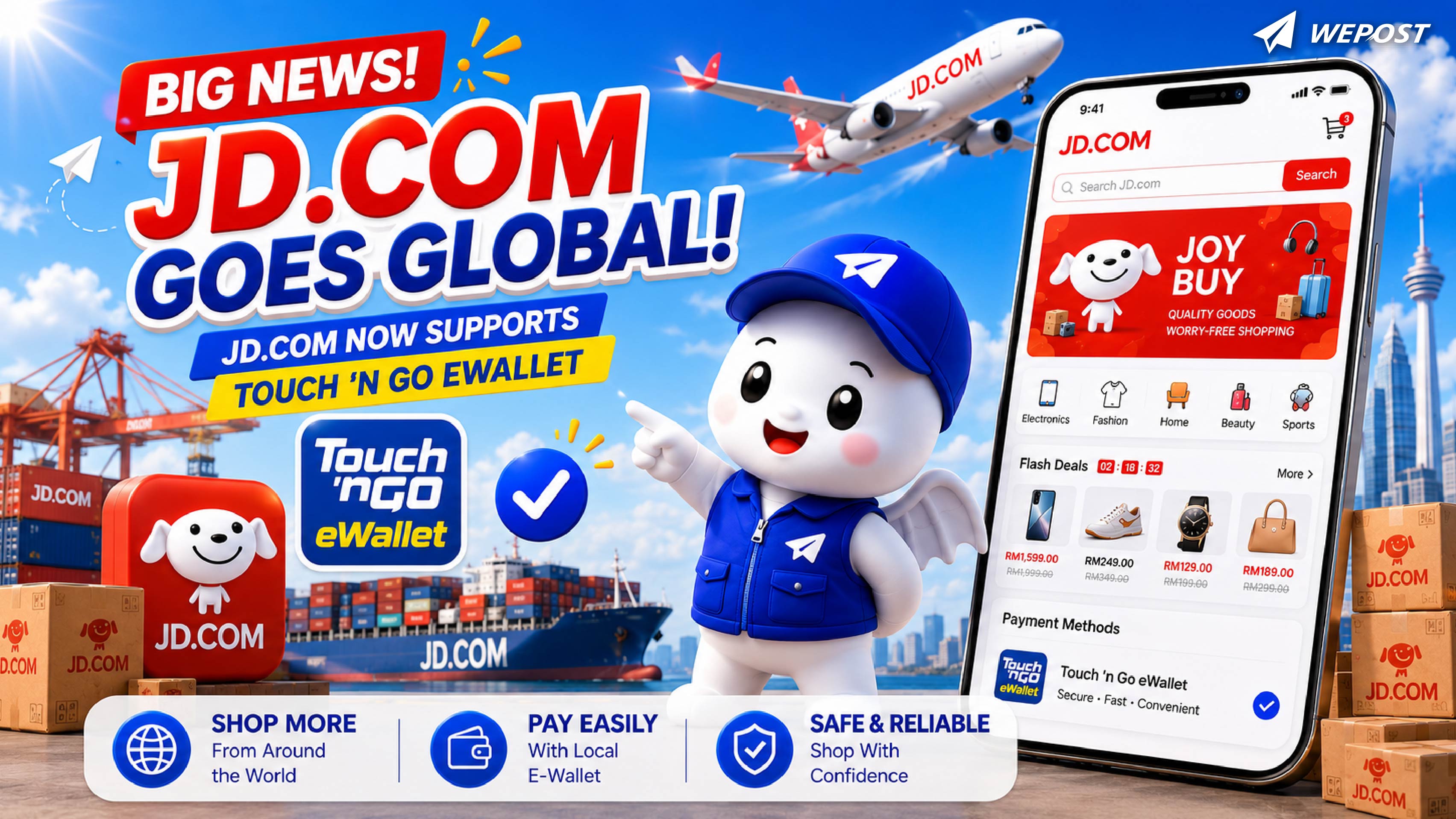
Against this backdrop, JD.com’s support for or integration with TNG eWallet in relevant scenarios is worth observing within the broader trend of cross-border e-commerce localization. It is not simply a change in payment options, but a key piece of infrastructure that Chinese e-commerce platforms must complete when competing for users in Southeast Asia.
TNG eWallet is one of the most representative e-wallets in Malaysia. Its functions cover everyday financial scenarios such as top-ups, payments and transfers, and it is operated by TNG Digital Sdn. Bhd.
According to the official TNG Help Centre, TNG eWallet is an electronic wallet service that holds electronic money and is licensed by Bank Negara Malaysia. This means it is not merely an ordinary third-party tool, but a regulated local wallet with a broad user base that forms part of Malaysia’s digital payment ecosystem.
From a market perspective, Malaysia is currently experiencing a period of rapid adoption of electronic payments.
According to Bernama, citing Bank Negara Malaysia’s 2025 Annual Report, Malaysia recorded 18.4 billion electronic payment transactions in 2025, an increase of 25% from 2024. The number of electronic payment transactions per capita also increased from 432 to 538.
DuitNow QR transaction volume also doubled to 3 billion transactions in 2025, showing that Malaysian consumers have already developed a high-frequency habit of using QR payments and e-wallets.
This is precisely where TNG creates strategic value for JD.com. For cross-border e-commerce platforms, the closer the payment method is to local consumer habits, the higher the conversion potential. If Malaysian users see TNG as a payment option on JD.com or within relevant cross-border shopping journeys, they do not need to rely on unfamiliar international bank cards, complicated foreign currency conversions, or third-party payment services to complete a transaction.
A shorter payment journey naturally makes purchase decisions easier. However, based on publicly available information, it is still important to distinguish between “TNG is directly supported across the entire JD.com platform” and “TNG is supported in certain cross-border scenarios, partner channels or checkout environments.”
JD.com’s Help Centre shows that its checkout supports JD Pay, WeChat Pay, UnionPay, Apple Pay, Huawei Pay and other payment methods, but the actual payment methods available depend on the checkout page displayed after an order is submitted.
In other words, whether TNG appears may depend on the region, product, order type, payment channel and partnership model.
From an industry perspective, JD.com’s expansion of TNG support is not unexpected. JD Worldwide has been continuously strengthening its cross-border payment capabilities.
In 2021, JD Worldwide partnered with Visa, emphasizing a safer and more convenient cross-border payment experience for overseas consumers. In 2024, UnionPay International announced a partnership with JD Pay, enabling JD Worldwide export scenarios to support online payments using UnionPay cards issued overseas.
These moves show that JD.com is not simply exporting products to overseas markets, but is also building out payment, logistics, settlement and localized service capabilities.
TNG’s cross-border capabilities have also continued to expand. In 2022, Touch ’n Go announced that TNG eWallet had expanded into cross-border payment scenarios in mainland China through Alipay+, becoming one of the Malaysian e-wallets that could be used for payments in mainland China.
Alipay+’s official materials also identify Touch ’n Go eWallet as one of its supported mobile payment partners. In other words, TNG already has the technological and ecosystem foundation to connect Malaysian users with Chinese consumption scenarios.
For JD.com, supporting TNG mainly creates value in three areas. First, it lowers the payment barrier for Malaysian users, particularly those without Chinese bank cards, Alipay or full access to WeChat Pay.
Second, it strengthens the platform’s localized image in Southeast Asia, making users feel that JD.com is not simply a “foreign platform”, but one that can adapt to local consumer habits.
Third, it helps Chinese brands expand overseas, particularly in categories suitable for cross-border sales such as 3C electronics, home appliances, beauty products, mother and baby products, apparel and everyday consumer goods.
For Malaysian consumers, the core value is certainty. What users care about is not how many payment methods a platform promotes, but whether they can successfully complete payment at checkout, whether exchange rates are transparent, whether refunds are returned through the original payment channel, and whether customer service can handle cross-border disputes.
Therefore, if JD.com further expands TNG payment scenarios, it will also need to improve exchange rate displays, fee disclosures, refund procedures, order cancellation rules and after-sales support.
Overall, JD.com’s support for TNG can be viewed as a signal that Chinese e-commerce platforms are accelerating their localization in Southeast Asia. In the past, cross-border e-commerce competition focused on product prices, logistics speed and authenticity guarantees;
Today, payment experience is becoming the new competitive frontier. Platforms that allow users to complete cross-border purchases using local wallets, local currency and familiar processes will find it easier to build trust in overseas markets.
Decoding JD.com’s Expansion in Malaysia
“JD.com remains firmly committed to a core strategy centered on supply chains, using supply chain infrastructure as the foundation for its internationalization.” — JD.com official statement, January 2023.
In January 2023, JD.com announced the closure of its five-year-old Thailand platform, JD Central, and Indonesia platform, JD.ID.
Many interpreted the move as a graceful retreat. Yet around the same period, JD Logistics quietly opened its second self-operated overseas warehouse in Malaysia — a modern logistics centre spanning nearly 10,000 square metres and holding a U.S. LEED green building certification.
This contrast between “e-commerce contraction and logistics expansion” reveals JD.com’s real strategy in Malaysia: it is no longer competing directly for e-commerce traffic, but using another approach to redefine its position in Southeast Asia.
Malaysia is one of the markets where JD.com has made some of its deepest and most systematic investments in this “strategic shift” across Southeast Asia.
01. Historical Review: From “Closure” to “Restart” (2015–2023)
To understand JD.com’s current strategy in Malaysia, it is necessary to first examine the setbacks it experienced in Southeast Asia.
In 2016, JD.com began expanding into Southeast Asia with Indonesia as its starting point, launching JD.ID. In 2018, JD.com and Thai retail group Central Group formed the joint venture e-commerce platform JD Central. JD.com also invested in Southeast Asian companies such as Thai online fashion brand Pomelo and Vietnamese e-commerce platform Tiki.
This was an ambitious multi-market expansion. The results, however, were disappointing.
According to iPrice data, JD Central’s average monthly visits in the first quarter of 2020 were around one million, while Lazada and Shopee maintained traffic in the tens of millions. According to Similarweb data, JD.ID recorded 2.3 million total website visits in October 2022, ranking 13th among Indonesian e-commerce websites, while Shopee ranked first with 179 million visits. (Source: Ebrun)
In January 2023, JD.com officially announced the closure of both platforms. JD.ID announced that it would cease all services on March 31, while the Thailand platform would shut down on March 3.
What was the fundamental reason for the failure?
Shopee and Lazada had already achieved deep localization, from payments and logistics to marketing language, creating strong consumer loyalty. JD.com’s “authentic products + fast delivery” advantages failed to create sufficient differentiation in markets where brand awareness and penetration were still relatively low.
This failure prompted JD.com to undergo a fundamental reassessment of its Southeast Asian strategy.
02. Logistics First: The Core Anchor of JD.com’s Malaysia Strategy
JD.com’s official positioning in Southeast Asia clearly defines its new strategic boundaries: it will concentrate resources on cross-border supply chain infrastructure in Southeast Asia and other markets, using supply chain infrastructure as the foundation for internationalization and continuously strengthening its global supply chain capabilities.
Among Southeast Asian markets, Malaysia has been given a particularly important position in JD.com’s new strategy.
As early as August 2022, JD Logistics entered into a strategic partnership with Malaysian mother-and-baby brand Anakku, providing warehousing and logistics distribution services to more than 1,000 stores nationwide. The partnership helped improve Anakku’s warehousing and fulfillment efficiency by more than 30%. This represents a typical approach: enter the local market through B2B partnerships with major clients, establish actual operational capabilities, and gradually expand the scope of services.
September 2024 marked an important milestone for Malaysia.
JD Logistics opened its second self-operated warehouse in Malaysia, covering 10,000 square metres. It provides B2B and B2C warehousing, 24-hour rapid fulfillment, reverse logistics, omnichannel fulfillment, transportation, customs clearance and other value-added services. The warehouse also obtained LEED green building certification, which represents one of the highest standards in Southeast Asian logistics warehousing.
Its air route network has also expanded aggressively. In October 2024, JD Logistics officially launched the Shenzhen–Kuala Lumpur international cargo route, using dedicated freighter aircraft to transport fresh Southeast Asian products such as durians and mangosteens into China, reducing the overall transportation time to within 24 hours.
In 2025, JD Logistics further upgraded its “Global Network” strategy, planning to more than double the area of its self-operated overseas warehouses globally by the end of 2025, while adding international routes including China–Malaysia, China–South Korea, China–Vietnam, China–US and China–Europe.
In October 2024, JD Logistics launched delivery services across seven Southeast Asian countries: Singapore, Malaysia, Thailand, Vietnam, Indonesia, the Philippines and Brunei. As of the first half of 2024, JD Logistics operated nearly 100 bonded warehouses, direct-mail warehouses and overseas warehouses globally, with a total managed area of nearly 1 million square metres, covering major markets including the United States, Germany, the Netherlands, France, the United Kingdom, Vietnam, the UAE, Australia and Malaysia.
In 2025, JD Logistics subsidiary JoyLogistics launched integrated delivery and installation services for bulky goods in Malaysia and Singapore. This marks an upgrade of JD.com’s service capabilities in Malaysia from “standard parcel delivery” to “supply chain solutions” — not only delivering small parcels, but also transporting and installing furniture and home appliances, which reflects one of JD.com’s core strengths in China.
03. E-Commerce Returns: JD Worldwide and the Free-Shipping Strategy
Once the logistics network was established, JD.com’s e-commerce business returned to Malaysia with a “cross-border” rather than “local” approach.
In September 2024, JD.com launched its JD Worldwide business, covering four markets: the United States, Japan, Singapore and Malaysia. Unlike the previous JD Central “local e-commerce” model, JD Worldwide is essentially a “main platform going overseas” strategy — bringing products from JD.com’s self-operated stores and third-party sellers directly to overseas consumers, with JD.com handling cross-border logistics fulfillment.
JD Worldwide focuses on competitive pricing. Users can switch between country sites within the JD.com app, with products including both JD.com self-operated goods and third-party merchant products. JD.com also displays reference prices from competitors to highlight its own pricing advantages.
During the Double 11 promotion in November 2024, JD Worldwide officially added Malaysia and Thailand to its “overseas free-shipping zones” and launched dedicated sites for both markets.
Malaysian users could enjoy free shipping by sea for orders above RMB399 and up to 6kg, or free standard air shipping for orders up to 2kg. Orders weighing 2kg or less could also be upgraded from sea freight to air freight free of charge. (Source: Sina Finance)
The previous “local platform” model required heavy investment and high operating costs. The current JD Worldwide model instead uses mature supply chain capabilities to directly provide cross-border shopping services to overseas consumers.
04. Competitive Landscape: Differentiation Under Pressure
Malaysia’s current e-commerce market presents a “three-way competition plus emerging players” landscape. Shopee and Lazada, as established market leaders, have strong user bases and merchant networks. Temu has entered rapidly with ultra-low prices and convenient TNG payment, while TikTok Shop is disrupting traditional shopping experiences through content-driven commerce.
JD.com’s differentiation lies in its “asset-heavy supply chain” rather than “traffic operations”. Shopee and Lazada focus on platform matchmaking and marketing capabilities, Temu relies on social-driven growth and low prices, while JD.com is betting on a combination of “logistics speed, product authenticity and bulky-goods fulfillment”.
This differentiation is even more advantageous in the B2B sector. For Chinese brands that need to establish local inventory in Malaysia, JD Logistics provides end-to-end services covering warehousing, transportation, customs clearance and last-mile delivery. For Malaysian retailers, JD.com’s supply chain capabilities can help improve inventory turnover and fulfillment efficiency.
The Anakku case demonstrates that JD Logistics can help local businesses achieve more than 30% improvement in fulfillment efficiency.
However, the challenges are equally significant. JD.com’s “asset-heavy” model means high investment, long cycles and slow returns. In 2024, JD Logistics recorded total revenue of RMB182.8 billion and operating expenses of RMB164.139 billion, leaving only a relatively thin profit margin.
In Malaysia, JD.com faces higher labor, land and compliance costs than in China, while also competing directly with logistics giants such as DHL, SF International and J&T Express.
In addition, JD.com’s brand recognition among Malaysian consumers remains relatively limited. Compared with the sustained marketing investments of Shopee and Lazada, JD.com has had relatively little visibility in the Malaysian market. Low market awareness and limited localization, including the absence of a locally operated team, remain challenges that JD.com must address.
Conclusion
From 2015 to 2023, JD.com entered Southeast Asia as an e-commerce platform, suffered setbacks and paid a price amounting to billions of yuan, but gained valuable lessons about local market operations.
Since 2023, JD.com has returned in the form of a logistics and supply chain provider, no longer pursuing short-term GMV growth, but building a “cross-border + local” dual-layer infrastructure — connecting Chinese supply chains with the Malaysian market at the cross-border level while establishing a local presence to serve Malaysian businesses.
Richard Liu has described JD.com’s overseas role as “building roads and bridges” — first establishing local warehousing and logistics capabilities, then expanding into e-commerce based on fulfillment capabilities.
This approach differs significantly from the “spend heavily on marketing first” model. JD.com has not relied on celebrity endorsements or massive offline advertising campaigns, but instead seeks to replicate its proven domestic model of “asset-heavy investment + high efficiency” supply chain capabilities in Malaysia.
Malaysia is a microcosm of JD.com’s Southeast Asian strategy. It has both a mature e-commerce market and rapidly growing consumer demand, as well as developed infrastructure and significant room for efficiency improvements.
JD.com’s “second landing” is not simply a business restart, but a transformation of its business model — from “selling goods” to “providing services”, and from “platform” to “infrastructure”.
After all, in the ultimate competition of e-commerce, whoever controls the supply chain controls pricing power; whoever controls logistics speed controls the consumer’s mindshare.
JD.com’s development in Malaysia is now putting this business principle to the test.
Written by: WePost Marketing Department DONG JI
 New Parcel
 Parcel
 Shipment
 Alipay Services
 Shopping Cashback
 Local Shipping
 Reviews
 Enquiry
 Shopping
 Cart
Cart
 Order
Order
 Favourite
 Dashboard
 My Wallet
 Address Book
 Coupon
 Merchant Voucher
 Clubs
Clubs
 My Friends
 Donation
 Share
Share
 Help Center
 Settings
 WePost Pro
 Community
 Lucky Draw