Truck Speed Limiters in Malaysia: Necessary or Unnecessary?
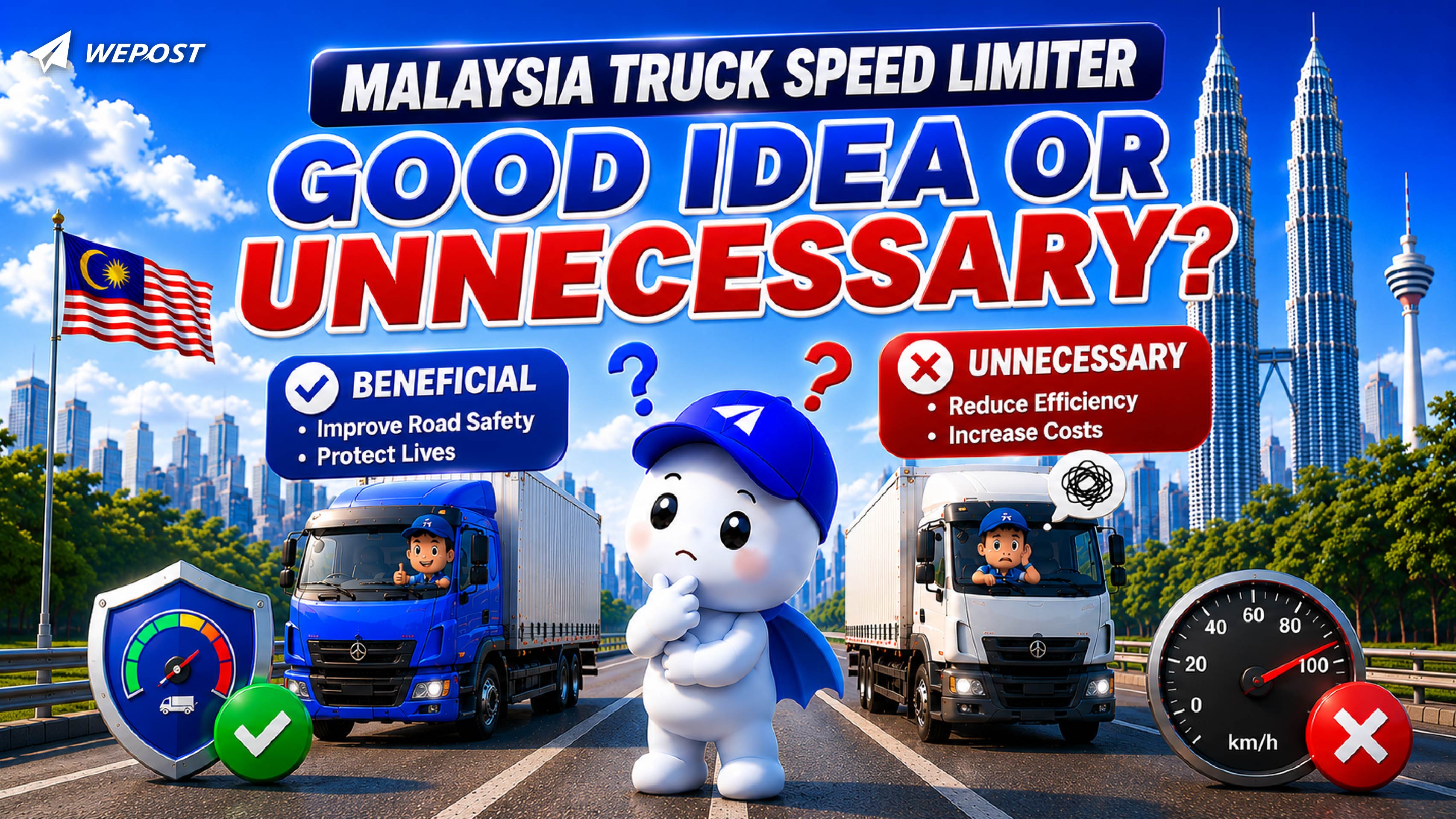
Truck Speed Limiters in Malaysia: A Necessary Safety Measure or an Unnecessary Burden on the Logistics Industry?
On Malaysian roads, trucks are more than just transportation vehicles. They connect ports, warehouses, factories, supermarkets, construction sites, and support the entire logistics ecosystem.
Without trucks, products would never reach store shelves, construction materials would not arrive at project sites, and e-commerce parcels could not be delivered on time. However, when a truck loses control, the consequences are often far more severe than those involving ordinary passenger vehicles.
The weight, momentum, and braking distance of a fully loaded truck are incomparable to those of a standard car. A slight increase in speed on the highway can significantly amplify the risks.
That is why, when Malaysia began pushing for speed limiters on trucks and commercial vehicles, two opposing views naturally emerged.
Supporters believe it is a necessary measure to protect lives, while critics argue that it creates an unnecessary financial burden on the transportation industry.
So, are truck speed limiters beneficial or unnecessary? In my view, they are not excessive; they are a safety baseline that the industry would eventually have to adopt.
However, if speed limiters are implemented without addressing broader industry management issues, they will never be a complete solution.
01. Why Can't We Simply Rely on Drivers' Self-Discipline?
Many road safety issues cannot be solved solely through personal responsibility.
If speeding is dangerous for ordinary drivers, it is even more dangerous for heavy commercial vehicles. A truck is not a lightweight vehicle; it is a fast-moving heavy-duty machine.
When a truck travels at excessive speed, three major risks emerge simultaneously.
First, longer braking distances. Even when a driver reacts immediately to a hazard, the vehicle may not be able to stop in time.
Second, reduced maneuverability. Lane changes, evasive actions, and downhill driving become significantly riskier at higher speeds.
Third, more severe accident consequences. While a typical collision may affect one or two vehicles, a truck accident can easily result in multi-vehicle crashes and widespread traffic disruption.
Therefore, the primary purpose of speed limiters is not to restrict drivers from earning a living, but to keep heavy vehicles operating within a reasonable safety range.
They are not designed to punish truck drivers; they are meant to protect all road users, including the truck drivers themselves.
02. For the Public, Speed Limiters Provide Reassurance
Many Malaysian motorists have experienced a situation where they are driving normally on the highway when a large truck suddenly approaches rapidly from behind. Others have witnessed heavy vehicles changing lanes aggressively during rainy and slippery conditions.
In those moments, what ordinary drivers feel is not "logistics efficiency" but rather a sense of pressure and insecurity.
The purpose of speed limiters is to reduce this uncertainty.
They cannot eliminate accidents entirely, but they can reduce the destructive impact of high-speed truck-related incidents.
Much like seat belts, airbags, and ABS braking systems, speed limiters are not magical solutions.
However, they can significantly reduce the severity of injuries and damage when accidents occur.
For ordinary road users, truck speed limiters are not unnecessary equipment—they are a form of public safety protection.
After all, public roads do not belong exclusively to transport companies; they are shared spaces used by everyone.
03. For the Logistics Industry, It Is Indeed an Additional Pressure
Of course, from the perspective of logistics companies and truck drivers, speed limiters are not entirely without drawbacks.
Installation, inspection, certification, and maintenance all involve additional costs.
Large logistics operators may be able to absorb these expenses more easily, but for small transport companies, owner-operators, and drivers who rely heavily on delivery volume, these costs can become a significant burden.
An equally practical concern is that restricted speeds may increase travel times. Longer travel times can reduce vehicle utilization rates, which may ultimately affect revenue and delivery efficiency.
Businesses that have long depended on tight delivery schedules and time-compressed operations will likely feel the impact most strongly.
Therefore, resistance from the industry is understandable.
Many are not necessarily opposed to safety measures. Rather, they worry that the policy could become a situation where drivers bear the costs, companies shift responsibility, and efficiency losses receive no compensation.
That is the real concern.
04. The Problem Is Not the Speed Limiter—It Is Poor Implementation
The success of any policy depends not only on its intention but also on how it is implemented.
The direction behind truck speed limiters is generally correct. However, poor implementation can easily create dissatisfaction within the industry.
For example: Are certification requirements clear? Are installation costs transparent? Who is responsible for maintenance? How should older vehicles be handled? Will smaller transport operators receive a transition period? Will enforcement be fair across companies of all sizes?
If these issues are not addressed properly, even a well-intentioned safety policy may be viewed simply as another reason to issue fines.
For speed limiters to achieve their intended objectives, governments must provide clear guidelines, simplify processes, keep costs reasonable, and ensure fair enforcement.
Otherwise, a safety initiative risks becoming an administrative burden.
05. Speed Is Not the Only Risk
That said, we must also acknowledge that truck accidents are not caused by speeding alone. Many incidents stem from deeper issues within the transportation industry.
One example is driver fatigue. Some drivers spend excessively long hours on the road in order to meet delivery targets, often operating vehicles while physically and mentally exhausted.
Another issue is overloading. When trucks carry loads beyond their designed capacity, braking systems and tires are subjected to greater stress, significantly increasing safety risks.
There is also the problem of insufficient vehicle maintenance. Brake systems, tires, lighting, and suspension components that are not properly inspected and maintained can become serious hazards.
In addition, unreasonable scheduling practices can contribute to accidents. When logistics companies focus solely on delivery deadlines without providing adequate rest periods, safety risks are effectively transferred to drivers and other road users.
Therefore, speed limiters can only address the issue of vehicle speed. They cannot solve all of the management challenges facing the transportation industry.
If speed limiters are installed while fatigue driving, overloading, and poor vehicle maintenance continue unchecked, accident risks will remain.
Effective road safety is not achieved through a single device, but through a comprehensive system. Speed limiters are merely the first step.
06. Not an Unnecessary Burden, but the Beginning of Industry Upgrading
In the long run, truck speed limiters may encourage the logistics industry to modernize.
For years, some transportation models have relied on low costs, high workloads, and aggressive delivery schedules.
The faster a driver could travel, the more jobs could be completed. The tighter the schedule, the more efficient the operation appeared to be.
However, this type of efficiency is often built upon increased risk.
Future logistics competition should not focus solely on who can move goods the fastest. It should also prioritize who can operate more safely, consistently, and compliantly.
Large customers, e-commerce platforms, cross-border logistics providers, and brand owners increasingly evaluate logistics partners based not only on pricing, but also on safety records, on-time performance, regulatory compliance, and service reliability.
Viewed from this perspective, speed limiters may represent a short-term expense, but they could also accelerate the industry's transition from traditional transportation practices to professional logistics operations.
A mature logistics industry should not depend on drivers taking unnecessary risks to maintain efficiency.
07. The Best Policy Is Not About Making Life Harder for Drivers—It's About Making Roads Safer
Malaysia's push for truck speed limiters is not simply about whether trucks are driving too fast.
At its core, it addresses a broader challenge: balancing economic growth and logistics efficiency with public road safety.
Truck drivers need to earn a living. Logistics companies need to fulfill deliveries. Consumers expect their goods to arrive on time. At the same time, ordinary road users deserve to travel safely.
These objectives should not come at the expense of one another.
The purpose of speed limiters is not to slow down logistics, but to ensure that logistics operations take place within safer and more responsible boundaries.
A society cannot pursue speed alone.
If greater speed comes at the cost of increased road danger, that efficiency is ultimately unsustainable.
Conclusion: Speed Limiters Are Necessary, But They Cannot Do Everything
Malaysia's truck speed limiter initiative is a good policy, not an unnecessary one.
When heavy vehicles are involved in high-speed accidents, the consequences affect not only drivers and transport companies, but everyone sharing the road.
However, speed limiters are not a universal solution.
If authorities focus solely on installation requirements without addressing certification costs, fair enforcement, driver fatigue, overloading, and vehicle maintenance, the effectiveness of the policy will be limited.
A more accurate conclusion would be this: speed limiters are a necessary safety baseline, but they are not the complete answer to road safety.
For the public, they provide greater peace of mind. For the logistics industry, they introduce short-term operational costs.
For Malaysia's transportation system as a whole, they represent a step toward greater standardization and professionalism.
The real question is not whether speed limiters should exist.
The real question is whether Malaysia can implement this policy fairly, transparently, and effectively over the long term.
If it can, speed limiters may save lives. If not, they risk becoming just another burden on the industry.
Written by: WePost Marketing Department – DONG JI
 New Parcel
 Parcel
 Shipment
 Alipay Services
 Shopping Cashback
 Local Shipping
 Reviews
 Enquiry
 Shopping
 Cart
Cart
 Order
Order
 Favourite
 Dashboard
 My Wallet
 Address Book
 Coupon
 Merchant Voucher
 Clubs
Clubs
 My Friends
 Donation
 Share
Share
 Help Center
 Settings
 WePost Pro
 Community
 Lucky Draw